
Which Chocolate Bars Are Made in Canada? A Guide to Canadian Chocolate Bars
Updated: Oct 16
Canadians have a soft spot for chocolate bars. Some people grew up with them in lunch boxes. Some remember buying them from corner stores after school. Some have very strong opinions about which bar is underrated, which one changed, and which one is not as good as it used to be. Chocolate is emotional like that.
But there is one question that has become more common lately: which chocolate bars are actually made in Canada?
That question sounds simple, but it gets tricky fast. A chocolate bar can be sold in Canada, loved in Canada, packaged for Canadians, owned by a company operating in Canada, or strongly associated with Canadian childhood memories without necessarily being fully Canadian-made. Some bars are manufactured in Canada. Some are imported. Some use imported cocoa but are made or finished in Canada. Some carry Canadian-style branding but need a closer look before you know what that really means.
So, if you are trying to choose Canadian chocolate bars, the best place to start is not the front of the package. It is the label, the manufacturing information, the claim wording, and the company behind the product.
This guide explains how to tell which chocolate bars are made in Canada, what common Canadian food labels mean, why cocoa itself is usually imported, and how to choose better chocolate when you want to support Canadian chocolate makers, local chocolatiers, and Canadian chocolate manufacturers.

Quick Answer: Which Chocolate Bars Are Made in Canada?
Chocolate bars that are made in Canada are usually labelled with wording such as “Made in Canada,” “Made in Canada from imported ingredients,” or similar manufacturing statements. Some may also be produced by Canadian chocolate factories, local chocolatiers, or private-label chocolate manufacturers that make bars in Canadian facilities.
The important detail is that most cocoa does not grow in Canada, so a chocolate bar can still be made in Canada while using imported cocoa, sugar, vanilla, nuts, or other ingredients. That is why “Made in Canada” and “Product of Canada” do not mean the exact same thing. A chocolate bar made in Canada may be manufactured, blended, molded, packaged, or finished in a Canadian facility, even if the cocoa beans or other ingredients came from outside the country.
If you want Canadian-made chocolate, look for clear label wording, a Canadian manufacturing address, local chocolatier information, or confirmation from the brand. Do not rely only on a maple leaf, a Canadian-sounding name, or the fact that the chocolate bar is popular in Canada.
That last part matters more than people think.
Why “Canadian Chocolate Bar” Can Mean Different Things
When people say “Canadian chocolate bar,” they may mean a few different things. One person may be talking about chocolate bars that are made in Canada. Another person may be talking about chocolate bars that are only sold in Canada. Someone else may mean bars that Canadians grew up eating, even if the ownership or manufacturing has changed over time.
Those are not the same category.
A bar can be culturally Canadian without being fully made from Canadian ingredients. A bar can be made in Canada from imported ingredients. A bar can be sold mainly in Canada but produced elsewhere. A bar can also be made by a Canadian chocolatier in small batches using cocoa from another country.
This is where the conversation gets messy. People often want a clean answer, but food supply chains are not always clean. Chocolate especially depends on global agriculture because cacao trees grow in tropical climates. Canada has many talented chocolate makers and manufacturers, but the cocoa itself usually comes from regions where cacao can actually grow.
So when you ask which chocolate bars are made in Canada, the better question is this: was the chocolate bar substantially made, processed, molded, finished, or packaged in Canada by a Canadian facility or chocolatier?
That is the more practical way to think about it.
What “Made in Canada” Means on Chocolate
On food labels, “Made in Canada” means the final substantial transformation of the food happened in Canada. For chocolate bars, that may mean the chocolate was processed, blended, molded, filled, packaged, or otherwise transformed into the finished product in Canada.
However, “Made in Canada” does not automatically mean every ingredient is Canadian. With chocolate, that would be unrealistic in most cases because cocoa beans are not commercially grown in Canada. If a chocolate bar says “Made in Canada from imported ingredients,” that can still mean the bar itself was manufactured or finished in Canada, even though the cocoa, sugar, vanilla, or other ingredients came from elsewhere.
This is not a bad thing. It is just how chocolate works.
What matters is clarity. A proper label should help customers understand whether the product was made in Canada and whether it used domestic, imported, or mixed ingredients. If a package only has a maple leaf or Canadian-looking design, that does not tell the whole story.
A maple leaf is a symbol, not a receipt.
If you care about buying Canadian-made chocolate, the wording matters. Look for specific claims instead of relying on patriotic packaging.
What “Product of Canada” Means for Chocolate
“Product of Canada” is a stronger claim than “Made in Canada.” It generally means the processing and labour are Canadian and that a very significant amount of the ingredients are Canadian. For some food categories, that is easier to achieve. For chocolate, it is more complicated because cocoa is typically imported.
That does not mean “Product of Canada” chocolate is impossible in every form, but it is less common than “Made in Canada from imported ingredients” because the main ingredient in chocolate comes from outside Canada. There may be Canadian dairy, Canadian packaging, Canadian labour, Canadian manufacturing, or Canadian inclusions, but the cocoa itself usually has an international origin.
This is why shoppers should not treat “Product of Canada” and “Made in Canada” as interchangeable. They are different types of claims.
If your goal is to support local chocolate makers, a “Made in Canada” chocolate bar from a Canadian chocolatier or chocolate factory may be exactly what you are looking for. If your goal is to buy products with mostly Canadian ingredients, you will need to read more carefully and understand that chocolate is not the same as maple syrup, wheat, dairy, or other products that can be grown or produced domestically at scale.
Chocolate is a global ingredient turned into a local product.
That is the honest answer.
Why Most Canadian Chocolate Still Uses Imported Cocoa
Cacao trees need warm, humid, tropical growing conditions. Canada, despite its many charms, is not exactly famous for tropical cacao plantations. Calgary winters alone would like a word.
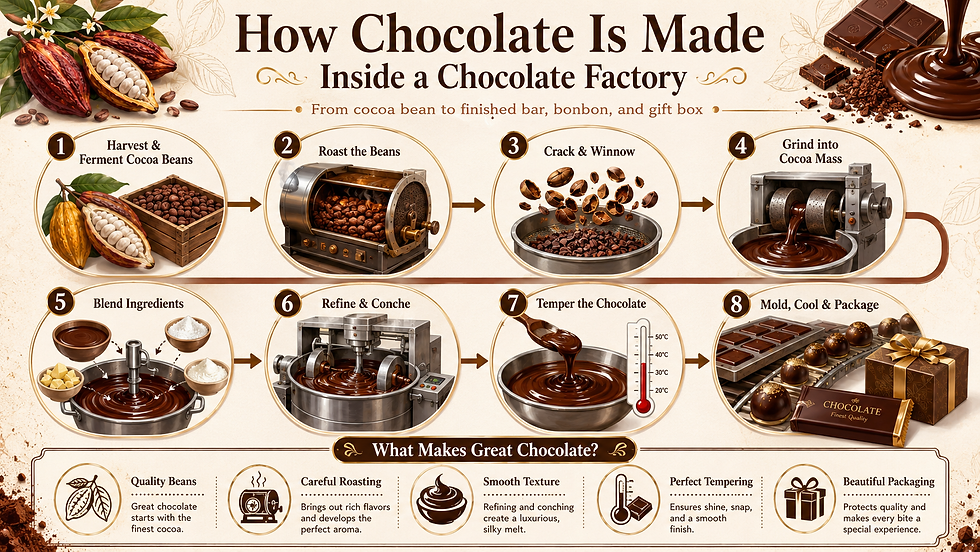
Because of this, Canadian chocolate makers almost always use imported cocoa beans, cocoa mass, cocoa butter, or chocolate couverture. That does not make the finished chocolate less valuable. It simply means Canadian chocolate makers are working with global cocoa and turning it into finished products through roasting, blending, refining, molding, decorating, packaging, and product development.
This is similar to coffee. Canada has excellent coffee roasters, even though coffee beans are not grown in Canada. The value comes from sourcing, roasting, blending, and preparing the product locally. Chocolate can work the same way.
A Canadian chocolatier may source cocoa from Ecuador, Peru, Ghana, Madagascar, the Dominican Republic, or other cocoa-producing regions, then make finished chocolate bars in Canada. Another Canadian chocolate factory may use imported chocolate couverture and turn it into custom bars, bonbons, bark, corporate gifts, fundraising bars, or private-label products.
Both can be Canadian-made in a practical manufacturing sense, depending on what happens in Canada and how the product is labelled.
How to Tell If a Chocolate Bar Is Made in Canada
The first thing to check is the back or side of the package. Look for wording that clearly explains where the product was made. The phrase “Made in Canada” is more useful than a vague front-of-package design. If the package says “Made in Canada from imported ingredients,” that means the finished food was substantially transformed in Canada, even though some or all ingredients came from outside the country.
Next, look for the manufacturer or company address. A Canadian address alone does not always prove the product was made in Canada, because some companies import products under a Canadian business name. Still, it gives you a starting point. If the label says “imported by” or “imported for,” that usually suggests the product was made outside Canada and brought in for sale.
You can also check the brand’s website. Many Canadian chocolate makers proudly explain where their products are made, what type of facility they use, and whether they offer local production, private-label work, or custom manufacturing. If the website is vague, you can contact the company directly.
For local chocolate bars, you may also find information from farmers’ markets, local shops, chocolate factories, or chocolatiers. Smaller Canadian chocolate makers are often more transparent because local production is part of their story. They usually want customers to know their chocolate is made nearby.
The main thing is to read beyond the front label. A package can look Canadian without telling you enough.
Canadian-Made vs Canadian-Owned vs Canadian-Sold
This is one of the biggest sources of confusion. Canadian-made, Canadian-owned, and Canadian-sold do not mean the same thing.
A Canadian-made chocolate bar is manufactured or substantially transformed in Canada. A Canadian-owned chocolate company is owned or operated by Canadians, but that does not automatically tell you where every product is made. A Canadian-sold chocolate bar is simply available for purchase in Canada, which could include imported products from anywhere in the world.
These distinctions matter because different shoppers care about different things. Some want to support Canadian labour and manufacturing. Some want to support Canadian-owned businesses. Some want local ingredients where possible. Some just want chocolate bars that remind them of growing up in Canada.
None of these goals are wrong, but they are not identical.
If you want to support Canadian factories and food manufacturing, prioritize clear “Made in Canada” claims and companies that identify Canadian production facilities. If you want to support local businesses, buy from Canadian chocolatiers, local chocolate factories, and small makers who produce in your city or province. If you want nostalgic Canadian candy, you may be looking at a different list altogether.
The phrase “Canadian chocolate bars” needs context before it can be useful.
Are Popular Canadian Chocolate Bars Actually Made in Canada?
Some chocolate bars are strongly associated with Canada because they are popular here, have a long history here, or are harder to find in other countries. That does not automatically mean every version is currently made in Canada.
Large confectionery brands can change manufacturing locations, ownership structures, packaging, and supply chains over time. A bar that was once produced in one facility may later be produced somewhere else. A product sold in Canada may have different manufacturing details depending on the package size, format, season, or distribution channel.
That is why any list of “Canadian chocolate bars” should be treated with caution unless it is based on current packaging or direct confirmation from the manufacturer.
For shoppers, the most reliable method is still the label. If a chocolate bar is made in Canada, the package should usually give you clues. If it says imported, that tells you something else. If it only gives a Canadian head office address without clear manufacturing details, you may need to look deeper.
This may not be as satisfying as a clean top-ten list, but it is more accurate.
And accuracy is useful when the goal is actually buying Canadian-made chocolate, not just feeling good beside a maple leaf.
Which Types of Chocolate Bars Are Most Likely to Be Made in Canada?
The chocolate bars most likely to be made in Canada are usually produced by local chocolatiers, regional chocolate factories, Canadian private-label manufacturers, bean-to-bar makers, and specialty food producers. These businesses often make smaller batches, custom bars, branded bars, fundraising bars, gift bars, and retail-ready chocolate products in Canadian facilities.
A local chocolatier may make handmade bars using high-quality chocolate and premium inclusions. A bean-to-bar maker may roast cocoa beans and produce bars from scratch in Canada. A chocolate factory may manufacture custom bars for businesses, schools, events, hotels, retailers, or corporate gifting programs. A private-label manufacturer may produce bars that are sold under another company’s brand.
These products may not always be as widely available as mass-market candy bars, but they are often easier to verify. Local chocolate makers usually make Canadian production part of their value. They may mention their city, facility, production process, or custom manufacturing services clearly.
For example, if you are in Calgary and looking for Canadian-made chocolate bars, a local chocolate factory or chocolatier is often a better place to start than a generic candy aisle. You are more likely to find products made nearby, with clearer information about who made them and how they can be customized.
Local chocolate is easier to trace because the maker is closer to the customer.
Why Local Chocolate Bars Are a Strong Choice
Local chocolate bars give you more than a sweet snack. They give you a connection to the maker, the city, and the occasion. When you buy from a local chocolate factory in Calgary or another Canadian city, you are supporting production work, packaging, design, and business activity closer to home.
Local bars are also more flexible. A large national candy company may sell one standard product to everyone. A local chocolate factory can often create custom flavours, branded wrappers, corporate gift bars, wedding favours, fundraising bars, and seasonal products for specific customers.
This matters for businesses and organizations. If a school needs fundraising chocolate, local production can help create a product that feels connected to the community. If a company needs client gifts, a locally made bar with custom packaging can feel more thoughtful than a generic imported box. If an event planner needs chocolate favours, a local chocolatier can often match the design, colours, and packaging to the event.
Local does not automatically mean better in every case, but it often means more personal, more flexible, and easier to customize.
That is a real advantage.
What About Chocolate Bars Only Available in Canada?
Some chocolate bars are famous because they are mostly associated with Canada or are easier to find here than in other countries. These are often the bars people mean when they search for “chocolate bars only available in Canada” or “chocolates only in Canada.”
This is a different question from “what chocolate bars are made in Canada?”
A chocolate bar can be known as a Canadian favourite because of where it is sold, how long it has been available here, or how strongly Canadians associate it with childhood. But availability and manufacturing origin are not the same thing. A bar may be commonly sold in Canada without being fully made from Canadian ingredients or manufactured in a Canadian facility.
If you are writing a shopping list for Canadian snacks to send to a friend abroad, then “only available in Canada” may be the right angle. If you are trying to support Canadian manufacturing, then “made in Canada” is the more important phrase.
The two lists may overlap, but they should not be treated as identical.
This distinction can save you from accidentally buying a product that feels Canadian but is not actually made here.
How to Choose Better Canadian Chocolate Bars
Choosing better Canadian chocolate bars starts with deciding what “better” means to you. If you care about local production, choose bars made by Canadian chocolatiers or chocolate factories. If you care about flavour, look for cocoa percentage, ingredients, freshness, and balance. If you care about gifting, look for packaging and presentation. If you care about business use, look for customization, volume capacity, and consistency.
For everyday eating, a simple milk chocolate bar may be perfect. For gifting, a premium bar with elegant packaging may be better. For corporate use, a custom branded bar can turn chocolate into a professional touchpoint. For fundraising, a bar needs to be easy to sell, easy to store, and priced properly. For retail, the product needs a strong wrapper, clear label, and reliable repeat production.
A good chocolate bar should taste good, look good, and make sense for the purpose. There is no need to overcomplicate it, but there is also no reason to pretend all bars are the same.
The best Canadian chocolate bars are usually the ones where the maker is clear about the product, the ingredients, the process, and the story.
What to Look for on the Label
When reading a chocolate bar label, start with the country-of-origin and manufacturing wording. Look for “Made in Canada” if your priority is Canadian production. Look for qualifying statements that explain whether the ingredients are domestic, imported, or mixed. If you see “Product of Canada,” understand that it is a stronger Canadian-content claim.
Next, review the ingredient list. A short ingredient list does not automatically mean the chocolate is better, but it can help you understand what you are eating. Dark chocolate may include cocoa mass, cocoa butter, sugar, vanilla, and sometimes lecithin. Milk chocolate may include milk powder or milk ingredients. White chocolate should contain cocoa butter if it is properly made.
Also check allergen statements. Chocolate bars may contain or come into contact with milk, nuts, peanuts, soy, wheat, or other allergens depending on the facility and recipe. This is especially important when buying chocolate for schools, offices, weddings, or public events.
Finally, look at freshness and storage guidance. Chocolate should usually be stored in a cool, dry place away from direct sunlight and strong odours. If a chocolate bar has fillings, nuts, fruit, or other inclusions, its shelf life may differ from a plain bar.
A good label should answer basic questions without making you feel like you are decoding a government file in a spy movie.
Are Canadian Chocolate Bars Good for Gifts?
Canadian chocolate bars can be excellent gifts, especially when they are locally made or thoughtfully packaged. A chocolate bar may seem simple, but with the right wrapper, flavour, and presentation, it can feel polished and personal.
For corporate gifts, Canadian-made chocolate bars work well because they are easy to customize and distribute. A business can add branded packaging, a thank-you message, event artwork, or seasonal design. For weddings and events, chocolate bars can become favours with names, dates, and colours matched to the occasion. For tourism and hospitality, Canadian-made bars can give visitors something local to take home.
Local chocolate bars are also useful for gift baskets. A Calgary-made chocolate bar in an Alberta-themed gift box feels more connected than a generic imported product. It tells a better story and gives the recipient something with a sense of place.
For personal gifts, bars are easy to pair with coffee, flowers, wine-free gift baskets, books, candles, or other treats. They are also easier to ship and store than more delicate chocolates, which makes them practical.
A good chocolate bar can be small and still feel thoughtful.
Are Canadian Chocolate Bars Good for Fundraising?
Chocolate bars are one of the most practical fundraising products because people understand them immediately. They are easy to explain, easy to carry, easy to price, and easy to sell in volume. That is why schools, teams, clubs, and community organizations often choose chocolate bars for fundraising campaigns.
Canadian-made fundraising bars can make the campaign feel more local. If a school in Calgary sells chocolate bars made by a Calgary chocolate factory, the fundraiser has a stronger community connection. Supporters are not just buying chocolate; they are supporting a local cause and a local producer at the same time.
For fundraising, the best bar is not always the most complicated one. It needs to taste good, be affordable enough for impulse purchases, and have packaging that clearly explains the fundraiser. If the bar is too expensive, too fragile, or too unusual, it may become harder to sell.
The goal is not to impress five chocolate critics. The goal is to help a group raise money without turning every volunteer into a full-time salesperson.
How Local Chocolate Factories Make Custom Bars
A local chocolate factory can make custom bars in ways that a regular retail chocolate shop may not be able to support. Depending on the factory, customization can include flavour selection, toppings, molds, bar size, wrapper design, labels, boxes, and branded packaging.
The process usually starts with the purpose of the bar. A corporate gift bar may need a polished wrapper and clean logo placement. A fundraising bar may need simple packaging, clear pricing, and durable handling. A wedding bar may need soft colours, names, dates, and a romantic design. A retail bar may need stronger shelf appeal and consistent production.
Once the purpose is clear, the factory can recommend the chocolate type, flavour direction, packaging style, order quantity, and timeline. This is where working locally can help. Communication is easier, samples may be easier to review, and pickup or delivery can be more straightforward.
Custom chocolate bars are especially useful because they combine practicality with personalization. They are less delicate than some filled chocolates, easier to distribute than large gift boxes, and more memorable than generic promotional items.
People throw away brochures. They are less likely to throw away chocolate.
Common Mistakes When Buying Canadian Chocolate Bars
One common mistake is assuming that a Canadian-looking package means the bar is made in Canada. A maple leaf, mountain design, red-and-white colour palette, or Canadian address does not tell the full story. You still need to check the wording.
Another mistake is confusing Canadian favourites with Canadian-made products. Some bars are culturally connected to Canada but may not always be manufactured here. Manufacturing details can change, so label-checking is more reliable than memory.
A third mistake is buying chocolate bars for a large group without thinking about storage, allergies, and timing. Chocolate can melt, absorb odours, or develop texture issues if handled poorly. If you are buying for schools, offices, events, or fundraisers, you need to think practically.
The final mistake is choosing only by price. Cheap chocolate may work for some situations, but if the bar is being used as a gift, brand touchpoint, or event favour, the packaging and quality matter. A low-cost bar that looks careless can make the whole gift feel careless.
Chocolate may be small, but it still represents the person or business giving it.
Final Thoughts: The Best Canadian Chocolate Bars Are Clear About Where They Come From
So, which chocolate bars are made in Canada?
The best answer is that Canadian-made chocolate bars are the ones with clear manufacturing claims, transparent labels, and production that happens in Canada. Many of them are made by local chocolatiers, regional chocolate factories, private-label manufacturers, and Canadian food producers using imported cocoa and other ingredients. That is normal for chocolate.
If you want to buy Canadian-made chocolate, do not rely only on nostalgia, packaging, or maple leaf graphics. Read the label. Check the wording. Look for the maker. Ask where the bar is produced. Choose local when you can, especially if you want custom bars, gift bars, fundraising chocolate, or business-ready packaging.
Canadian chocolate is not defined only by where the cocoa grew. It is also shaped by where the chocolate was made, who made it, how it was packaged, and what purpose it serves.
A chocolate bar can be simple, but the story behind it can be surprisingly rich.
And honestly, that makes it taste a little better.
Made in Calgary, shipped across Canada. Calgary Chocolate Factory makes custom chocolate bars, corporate gifts and fundraising chocolate in our CFIA-licensed Calgary facility, with minimums from 50 units.
Ready to start? Email hello@calgarychocolatefactory.com


Comments